Reformer Pilates at home
Pilates has been booming in France in recent years. While it is often associated with mat practice, another method is attracting...
Pilates has been enjoying a real surge in popularity in France in recent years. While it is often associated with mat work, another method is attracting more and more followers: Reformer Pilates. This iconic apparatus, invented by Joseph Pilates himself, transforms the practice and offers a unique experience, open to everyone regardless of age or fitness level.
Thanks to digital platforms and machines designed for home use, it is now possible to practise on the Reformer at home and enjoy all its benefits. But how does it differ from mat Pilates? What results can you expect? And how do you get started safely?
This article takes stock of the benefits of Reformer Pilates, how it differs from the mat, who it is suited to and how to get off to a good start.
What is Reformer Pilates?
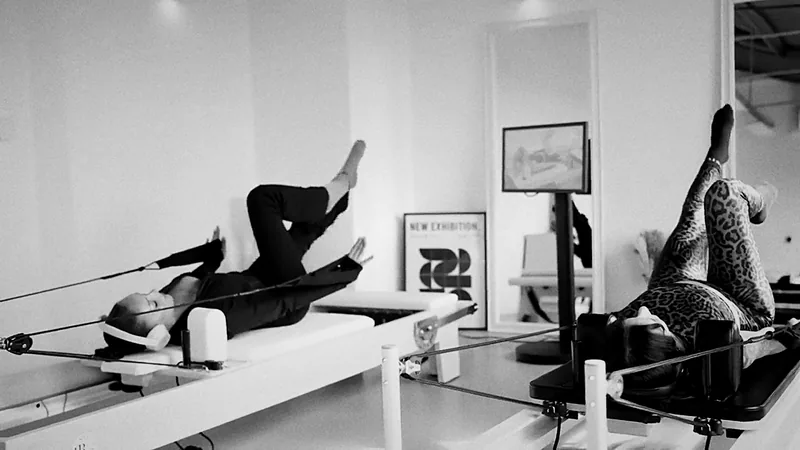
The Reformer is a machine that resembles a bed fitted with a sliding carriage mounted on rails and connected to adjustable resistance springs. It has a footbar, straps and shoulder blocks.
This ingenious system allows a wide variety of movements, working on muscle strength, joint mobility and coordination at the same time. Unlike the mat, where resistance comes only from body weight and gravity, the Reformer lets you fine-tune the intensity using the springs.
In France, Reformer classes are multiplying in studios, but many people now choose to install a Reformer at home, turning their living room or bedroom into a true mini-studio.
The benefits of Reformer Pilates
1. Deep, balanced muscle strengthening
The Reformer particularly engages the deep muscles of the trunk (abdominals, pelvic floor, lower back). Studies show that regular Pilates practice significantly improves lumbar stability and reduces the risk of chronic lower back pain.
A concrete example: a simple movement such as footwork (pushing the legs against the footbar) simultaneously strengthens the quadriceps, the glutes and the abdominal core, while being kind to the joints.
1. A lasting improvement in posture
By correcting muscle imbalances, Pilates helps to align the body. Practitioners report less pain linked to poor posture, particularly in the neck and shoulders.
This is especially beneficial for people who spend the whole working day sitting down.
1. A gentle, zero-impact practice
Unlike running or certain forms of fitness, the Reformer spares the joints. It is an ideal discipline for:
People returning to exercise after pregnancy (postnatal).
Seniors who want to maintain mobility and muscle tone without risk.
Athletes recovering from an injury.
Rehabilitation research shows that Pilates is effective at improving joint function and reducing pain in cases of mild to moderate osteoarthritis.
1. A method suited to every level
The Reformer is adaptable: the same exercise can be simplified or intensified by adjusting the springs. This allows everyone to progress at their own pace, from complete beginners to elite athletes.
1. A positive effect on the mind and on stress
Pilates places the emphasis on breathing and concentration. Several studies (e.g. Journal of Bodywork & Movement Therapies, 2020) have shown that regular Pilates practice reduces stress and improves sleep quality.